
Dual Inventive: International Activities
International Activities;
We continuously strive to innovate by developing cutting-edge rail safety technology products to help make the rail network safer and more efficient to all.
Over the past couple of months, the Development team alongside our trusty partners have been busy testing several new products:
· RCS 3000 (remote control signal)
· RSS 3000 PC (remote safety switch point controller), and
· RDI 3000v2 (remote detonator isolator).
RCS 3000
The RCS 3000 (remote-control signal) is operated through our secure cloud-based platform MTinfo 3000. The design is very similar to Dual Inventive’s core product - the ZKL 3000 RC (Remote-control Track Circuit Operating Device), with the exception of red LED stop lights.
The RCS 3000 replicates the function of a conventional railway signal to create a safe operational environment. It is usually deployed where lineside signals and train detection are not installed (logistics, depot etc) or where permanent power isn’t always available to activate the more traditional signals. The visibility of the red LED lights is critical – they must be clearly visible at a distance regardless of the weather.
The team conducted a light validation test to ensure the red LED lights can be seen by train drivers 200 metres away while travelling at least 40km/h. A marker point was set at 200m and if the red LED lights (signal) were seen before the marker point then this was a clear pass.
Train drivers who took part in this trial all reported they had clear visibility of the red LED lights before the marker points – resulting in a successful pass.
RSS 3000 PC (remote safety switch point controller)
In Germany, Deutcshe Bahn (the rail operator for Germany) is closing 175 miles sections (corridors) of national high-speed rail for 9 months to upgrade the rail infrastructure to improve reliability and capacity.
The 'DB S3' programme focuses on infrastructure modernisation across 40 major corridors - replacing tracks, switches, signalling equipment and overhead lines. This is totally different to how Network Rail undertake their major scheduled maintenance in the UK. It usually booked around annual rail possessions over Christmas or Easter period for a maximum of 3 to 4 days, or over daily nightshifts via line blocks to prevent disruption for passenger or freight services.
On the Hamburg-Berlin line, to ensure the safety of track workers, mains power for the rail signalling and traction power routed via buried cables or Overhead Line Equipment is isolated. Any mains powered devices are, therefore, temporarily redundant, including Siemens 'points switches' along the route,
unless manually operated via a ‘crank’ handle (an operative is required to undertake this procedure).
Whilst the rail corridor is closed for domestic and freight services, tracks are often used by on track plant and machines, equipment and welfare facilities to serve the worksite. This requires a rail operative to be positioned at every switch along the closed route to manually operate each set of points. From a safety and productivity perspective, this situation isn't ideal!
Deutsche Bahn approached Dual Inventive to automate this process whilst retaining 'Safety Integrity Level (SIL 4) safety compliance (the highest Safety Integrity Level available).
The project uses Dual Inventive’s Remote Safety Switch (RSS 3000), which also has product approval with Network Rail to provide remote protection to the workforce via MTinfo 3000.
In this instance, the RSS 3000 has been deployed in Schwarzenbek, connecting a bespoke battery powered 'off grid' points controller to switch tracks in accordance with desired rail movements.
These successful dynamic field tests act as our Proof of Technology and enables us to consider design or production enhancements for improved +performance and reliability so it can qualify for Deutsche Bahn client accreditation to use safely on the German railway.
Dual Inventive have been working with partners Deutsche Bahn and Condor on a several trials of the RSS 3000 PC in maintenance work areas. This was considered a problematic area as some point machines can sometimes disconnect from power, requiring manual operation which can be time consuming and lead to errors. In contrast the RSS 3000 PC can be operated remotely via MTinfo 3000 in a safe and controlled environment – from a position of safety whilst gaining efficiency.
RDI 3000 v2
The RDI 3000 (remote detonator isolator) is primarily deployed in France. Over the past year, the Development team have been actively refining the product to add significant advancements resulting in a more robust and improved version.
The RDI 3000 is used for demarcation of engineering work sites on active rail lines. It provides an additional layer of protection for track workers, improving safety during maintenance operations and reducing risk on site.
Like all products in Dual Inventive’s portfolio, the RDI 3000v2 is remotely operated through their secure, cloud-based MTinfo 3000 platform. Track workers can switch the device quickly and safely without manually placing flags, lamps, or detonators on the track – significantly reducing time spent in the four-foot and improving overall safety and efficiency.
The team recently tested the latest version in Belguim with Infrabel and Mobix and the results have provided a lot of insights into how the RDI 3000v2 can be implemented into Infrabel’s operations. This is yet another step forward to a safer and more insufficient rail infrastructure.
T3-A brings significant efficiencies
In 2017, there was a near miss at Camden Junction South involving Possession Support staff and a passenger train. This incident forced Network Rail to strengthen their safety measures to protect track workers while working in a dangerous working environment. It was investigated by the Rail Accident Investigation Branch, who are now focusing their efforts on reducing the risks associated with Possession Support staff working on track.
As a result, Network Rail’s Technical Authority, North and East Route and Dual Inventive, among others worked together on the Possession Limits Control project. The aim was to identify and trial innovative approaches to possession control – to minimise the need for staff to be on track during possession changes while utilising existing approved technology such as the ZKL 3000 RC.
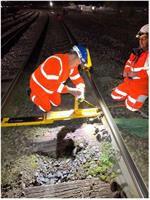
The ZKL 3000 RC is a remote-controlled track circuit operating device providing additional protection to track workers reducing risks associated with manual interventions out on track. It protects the work site making it safer for track workers to undertake maintenance work.
The first phase of the trial focused on possessions (T3) by carrying out signalling disconnections (D), whereas phase two looked at protecting the possession (T3) using existing additional protection (A) equipment such as the ZKL 3000 RC with the aim of replacing traditional methods such as the Possession Limit Boards and detonators.
In April 2024, the first trials of the T3-A were held at Selby Junction using the ZKL 3000 RC as the additional protection - the trial proved successful. And in January 2025 the new T3-A arrangement went live on the TransPennine Route Upgrade (TRU)
TRU led the way by embracing this methodology deploying ZKL 3000 RCs using technology to improve safety and efficiencies on the rail network between York and Leeds.
During the four-day trial, efficiencies gained totalled 1 hour and 33 minutes. Projected over a 52-weeks period, this equates to 80 hours 36 minutes of work time – a saving of 43.6% over 236 shifts.
The results of the trial led Network Rail to revise the possession process by amending the Rail Safety and Standard’s industry rule book, paving the way for nationwide implementation across UK’s rail infrastructure.
T3-A is now being rolled out across other routes in the UK including Southern and Anglia. Eastern, North West and Central and Wales still in the early stages so there’s still more work to do!
For more information get in touch, email us at info@dualinventive.com
Dual Inventive Ltd
-
Rachel Walker Communications & Engagement Manager
- January 19, 2026
- Send Email
